16 day Dune Adventure, Windhoek to Cape Town

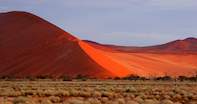
Dune 45 in the Namib Desert, Namibia.
Picture Gallery
Please note the 16 Day Dune Adventure is discontinued until further notice. Please enquire about excellent alternative Namibia rail safari options.

This train safari will take you from Namibia to Cape Town, providing an unforgettable African safari.


  • Find out Namibia's fascinating history at their local museum
  • Whale watching in Hermanus is an unforgettable experience
  • Take in the sights and sounds at the Victoria and Alfred Waterfront
  • Enjoy game drives in the majestic Etosha National Park on this train safari


  • This 16 day Dune Adventure, train safari explores the magnificent landscape of Namibia - a beautiful country of extreme contrasts, vast colurful deserts, dunes, almost extra-terrestial rock formations, great game reserves, delightful coastal towns with old world German hospitality, bushman settlements and the wild vitality of the South Atlantic seaborder. Add to this 3 days to enjoy and explore the many splendours of Cape Town where the tour starts or ends.

    Please note that this train safari can also be done in the reverse direction.

    Departure dates:
    Windhoek to Cape Town: 11 June and 26 July 2008
    Cape Town to Windoek: 4 July and 19 August 2008

    Pre-Day: Windhoek:
    You will be met upon arrival at Windhoek International Airport and transferred to the train. Having a pre-day means that one is able to acclimatise and unpack prior to the first day of touring. A pre-night on board will include dinner, bed and breakfast. The train remains stationary in Windhoek for the night.


    Day 1: Windhoek, Namibia

    Situated in Namibia's central highlands, Windhoek is an attractive city for a train safari, surrounded by clusters of hills and the impressive Auas and Eros Mountains.

    Windhoek City Tour:
    Part of this train safari is a city tour of Windhoek starts with a visit to the TransNamib Transport Museum. The museum is situated in the Windhoek Railway Station and was built from 1912 to 1913. In front of the building is the narrow-gauge locomotive (vintage 1900), that used to operate between Swakopmund and Windhoek.

    The museum at the Alte Feste Castle offers a range of displays, including the Social History Gallery and the Independence Display. Both give an insight into Namibia's complex history on your train safari. At the top of Robert Mugabe Avenue is the Christuskirche or Evangelical Lutheran Church.

    This is one of the city's most striking landmarks and was built from local sandstone and completed in 1910. Romanesque, neo-Gothic and Art Nouveau styles influenced its design and Kaiser Wilhelm II donated its stained-glass windows.

    Your last visit is the Namibia Craft Centre in the old Breweries Building. The rest of the day on the train safari is spent at leisure before you depart Windhoek in the late afternoon. The train journeys from Windhoek to Otavi over night. (Morning activity; distance travelled: +/- 50 kilometres (31 miles))

    Day 2: Grootfontein / Tsumeb / Ombili, Namibia

    Hoba Meteorite / Grootfontein / Tsumeb / Lake Otjikoto:
    You will visit the largest known meteorite in the world, the Hoba Meteorite. This 50 ton mass of nickel and iron, between 100 and 300 million years old, crashed to earth some 30 000 to 80 000 years ago. Your train safari will continue to Grootfontein for a visit to the Grootfontein Museum, before heading to Tsumeb for a lunch break (guest's own account).

    Morning Train Ride, Tsumeb Museum, Lake Otjikoto:
    You can choose to stay on the train during the morning, as it journeys from Otavi to Tsumeb. After arrival and lunch in town (guest's own account) you'll visit the Tsumeb Mining Museum. Here, a comprehensive collection of rare minerals can be viewed. In the Khorab Room one can see cannons and other armaments that were dumped into Lake Otjikoto by retreating German forces. This was done shortly before the signing of the Khorab Peace Treaty. There is so much African history to learn on this train safari.

    Your day ends with a visit to Lake Otjikoto, Namibia's largest permanent natural lake. As part of an underground river system, the lake was exposed when the roof of what was once a large dolomite cave, fell in. The lake is small with a diameter of about 102 metres, but very deep. The depth is estimated to be in excess of 142 metres in places. The train safari remains stationary in Tsumeb for the night. (Afternoon activity; distance travelled: +/- 30 kilometres (18 miles))

    Day 3: Etosha National Park, Namibia

    Ombili Bushmen Settlement and Etosha National Park:
    The Ombili Bushman Settlement is well worth a visit on your train safari. Home to some 300 San Bushmen, the Ombili Foundation was started to help preserve the San way of life. The foundation has helped raise funds to build a community centre, a pre-school and junior school and a small workshop. This visit (possible on school day mornings only) is regarded as one of the highlights of this train safari.

    You'll continue on your train safari to Etosha National Park, entering via the Namutoni Gate. The Etosha National Park is one of the major sanctuaries for wildlife in Africa and was proclaimed a game reserve by German Governor Von Lindequist in 1907. The heart of the park is the Etosha Pan (Etosha means 'place of dry water'). It is an extensive, flat depression of about 5 000 square kilometres. There are 144 mammal species in the park, which covers an area of 22 270 square kilometres.

    This includes Elephant, Giraffe, Blue Wildebeest and Black Rhino. Among the predators to be seen on this train safari are Lion, Cheetah, Leopard and several species of wild cat. Hyena and Jackal are the scavengers. Antelope species range from the majestic Eland to the shy little Damara Dik-Dik.

    The most striking of the antelope species is the Gemsbok, with its dramatic black and white markings. It also appears on the Namibian coat of arms. Bird life is prolific and some 340 species have been identified, including Namibia's national bird, the Crimson-Breasted Shrike.

    Lunch (guest's own account) is enjoyed before departing to Halali Camp in the Etosha National Park. Here you'll overnight in a tented camp. The train travels empty from Tsumeb to Otjiwarongo. It is not possible for guests to stay on board! (Full-day activity including an overnight in a tented camp; distance travelled: +/- 250 kilometres (155 miles))

    Day 4: Etosha National Park, Namibia

    After breakfast at Halali Camp, guests spend the day game viewing in Etosha. Lunch (guest's own account) can be enjoyed in the park. You'll exit the park via the Okaukuejo Gate and return to the train in Otjiwarongo in the late afternoon to continue on your train safari. Guests rejoin the train in Otjiwarongo from where it departs over night to Ebony. (Full-day activity; distance travelled: +/- 350 kilometres (217 miles))

    Day 5: Etosha National Park, Namibia

    This morning is the last opportunity to experience the magic of Etosha’s animal kingdom (this time in the southern region of the park and once again in air-conditioned vehicles). After lunch (guests’ own account) the tour departs for Otjiwarongo, where the train will await for the journey to the coast. (Half day; distance travelled: ± 350 km).

    The train departs for Swakopmund in the afternoon where it remains stationary after arrival.

    Day 6: Swakopmund / Walvis Bay, Namibia

    Swakopmund, Namibia's seaside resort on the West Coast, is a place of singular charm. It resembles a small Bavarian village nestling between the desert and the sea and has a restful and relaxing atmosphere. The source of Swakopmund's continental atmosphere is the graceful Art Nouveau buildings dating back to the turn of the century.

    Walvis Bay and Dune 7:
    This morning of your train safari, is free to explore the town. After an early lunch (guest’s own account) you'll depart for Walvis Bay. It is a pretty South African style town with 25 000 inhabitants. Strategically located halfway down the coast of Namibia and with direct access to principal shipping routes, it is a natural gateway for international trade. Visit the Walvis Bay Lagoon, a great attraction in the Walvis Bay area.

    The tranquil stretch of water, its natural beauty accentuated by thousands of flamingos gathering at the rich feeding grounds, is over 3 000 years old. Because of its value as a wetland area, it was declared a RAMSAR site (a convention pertaining to wetlands was held in Ramsar, Iran, in 1971). Dune 7, located on the outskirts of Walvis Bay, is the highest sand dune in the area. It is an unforgettable experience, for those who feel inclined to challenge the height of this outstanding landmark or to admire the view from the top whilst on this train safari. (Afternoon activity; distance travelled: +/- 80 kilometres (49 miles))

    Day 7: Swakopmund, Spitzkoppe and North Coast, Namibia

    Spitzkoppe is known as the 'Matterhorn of Namibia'. It rises to an altitude of about 1 800 m. However, it is by no means Namibia's highest mountain. Due to its striking features and outlines, it is the most famous mountain in the country.

    Situated in an endless dry landscape, the island of mountains can be seen from quite a distance. The enormous granite rocks were created more than 100 million years ago due to volcanic activities and subsequent erosion.

    The tour continues to the small, thriving town of Henties Bay. The town was named after Major Hentie van der Merwe, who discovered a freshwater fountain in the estuary of the Omaruru River. Lunch (guests’ own account) is enjoyed before visiting the Cape Cross Seal Reserve north of Henties Bay. Here a prodigious number of Cape Fur Seals flourish in the cold waters of the Benguela Current.

    Numerous islets and isolated parts of the shore serve as nurseries for their young. This area is also of historical significance, as the Portuguese navigator, Diego Cão, planted a cross at this point in the year 1486. The tour makes its way back to the train in Swakopmund in the late afternoon. (Full day; distance travelled: ± 350 km).

    The train remains stationary in Swakopmund over night.

    Day 8: Swakopmund, Namibia

    The day is spent at leisure.

    Specialised Activities

    Ocean and Desert Combination Tour:
    Guests depart from Walvis Bay for a Marine Seal and Dolphin Cruise around the bay. A light lunch of fresh oysters, snacks and sparkling wine is enjoyed on the beach.

    At Pelican Point, guides with 4 x 4 vehicles await to take you on a ride through a magnificent dune landscape. This tour offers the best of both worlds - the Atlantic Ocean and the Namib Desert! (Full day, including lunch; minimum of 4 participants per vehicle required; weather dependent).

    Sossusvlei Fly-in:
    You depart from Swakopmund, flying in a light aircraft over the Namib Desert and along the Kuiseb River. After passing over Tsondabvlei, the only known breeding area of the Lappet Faced Vulture in southern Namibia, you land at Sesriem, from where 4x4 vehicles take us to the highest shifting sand dunes in the world at Sossusvlei.

    No part of the desert is visually more stunning than here. The warm tints of the sand range from pale apricot to brick orange and deep red, vividly contrasting with the large white clay pans at some of their bases.

    Lunch will be enjoyed at Sossusvlei Lodge, after which the light aircraft will fly us over these earlier visited shifting sand dunes. From here you fly over the remains of three old diamond camps in the Diamond Restricted Area and cross the coastline at Conception Bay.

    You pass over colonies of Cape Fur Seals, as well as the “Eduard Bohlen” and “Shaunee” shipwrecks. With the Atlantic surf on the one side and the 'long wall' (Namib Dunes) on the other, you reach Sandwich Harbour, a wetland of international importance.

    After leaving Walvis Bay behind us, you land back in Swakopmund. (Full day, including lunch; distance covered: ± 630 km; minimum of 5 participants required).

    Epupa Falls / Ovahimba Fly-in:
    Everyone departs Swakopmund early morning in a light aircraft for a low-level scenic flight past the Brandberg and over Damaraland and Kaokoland towards Epupa Falls. After arrival at Epupa everyone is driven to an Ovahimba village in the area - accompanied by a guide and translator.

    Spend the morning with the Ovahimba in their ‘kraal’. The Ovahimba are a tribe of semi-nomadic pastoralists who still live and dress according to ancient traditions. They are tall, slender and statuesque people, characterised by their proud yet friendly bearing.

    The women are noted for their unusual sculptural beauty, enhanced by intricate hairstyles and traditional adornments. The Ovahimba rub their bodies with red ochre and fat to protect their skin against the scorching sun. On this day you will also be able to see the majestic Epupa Falls.

    The falls are a series of cascades where the Kunene River loops a total of 60 metres. With its richly coloured rock walls, variety of trees and waving Makalani Palms, the Epupa Falls offer much to see and experience. Lunch will be served at the Omarunga Camp on the riverbed of the Kunene River.

    In the afternoon you fly on to Opuwo to refuel, then fly along the Uniab Riverbed in search of Desert Elephant, Rhino, Giraffe, Mountain Zebra and other game up to the rivermouth area, turning southwards.

    You return along the treacherous Skeleton Coast. The Skeleton Coast Park stretches from the Ugab River in the south to the Kunene River, which forms the northern border with Angola. The Skeleton Coast is littered with whalebones, shipwrecks and remains of sailors and explorers.

    The flight further passes over Torra Bay, Palgrave Point, Toscanini, the Cape Cross Seal Reserve and Henties Bay, before we land back in Swakopmund. (Full day, including lunch; distance covered: ± 1 410 km; minimum of 5 participants required). The train remains stationary in Swakopmund over night.

    Day 9: Swakopmund, Namibia

    The morning is spent at leisure.

    Specialised Activities

    Sossusvlei – Classic Flight:
    Take to the skies on a journey over richly contrasting desert and coastal scenery. Fly over the Namib Desert and see the dry Kuiseb riverbed, which is the dune belt's natural border. Soar over imposing sand formations to Sossusvlei, where the world's highest shifting sand dunes are to be found.

    As you hover above the coastline, have a glimpse at shipwrecks, seal colonies and flamingos at Sandwich Harbour. Feel free as a bird as you pass over the salt flats of Walvis Bay and the picturesque town of Swakopmund before touching down to reality. (Duration: ± 2h30; minimum of 5 participants required).

    Conception Bay Flight:
    This flight affords stunning views of Swakopmund and its surroundings, including the Swakop River, Richthofen Farm, the Moon Landscape, Goanikontes Oasis, Namib Desert Park, Rössing Mines, Khan River, Walvis Bay, Kuiseb River, White Mountain, Conception Bay, the “Eduard Bohlen” shipwreck, seal colonies, the "Shaunee" shipwreck, the "Long Wall" dune ridge, Sandwich Harbour, the salt pans, Walvis Bay Harbour and Guano Island. (Duration: ± 1h20; minimum of 5 participants required).

    Quad Bikes:
    To explore the dunes, guests are equipped with fully automatic quad bikes. No prior experience is needed as this is a fully-guided tour. The dune sea teems with a multitude of insects and animals. These remarkable dune dwellers live their whole life in permanent contact with grains of sand.

    Their ties to this habitat are so binding that they cannot exist without it. Evolution has adapted these creatures by means of a complex array of extraordinary body structures, functions and behavioural traits. (Morning; duration: ± 3h30).

    Mola Mola Seal and Dolphin Cruise:
    Experience the thrill of dolphins leaping from the water alongside the boat, seals fed by hand, fresh oysters and cold champagne on the calm water of the Walvis Bay Lagoon. This morning-only activity is an experience not to be missed.

    (Morning; weather dependent) The train departs around midday from Swakopmund to Keetmanshoop (via Windhoek).

    Day 10: Fish River Canyon, Namibia

    Enjoy an early morning breakfast on your train safari before you depart for the Fish River Canyon. Eroded over millennia, the Fish River Canyon is the second largest natural gorge in Africa. Set in a harsh, stony plain, dotted with drought resistant succulents such as the distinctive quiver tree or kokerboom, the canyon is a spectacular natural phenomenon. It took hundreds of millions of years to evolve into its current shape. Its full length is 160 kilometres (99.4 miles), the width of up to 27 kilometres (16.7 miles) and the depth of 550 metres.

    After a quick stopover at the famous Canyon Roadhouse, which is interestingly decorated with old car parts found in the region, you'll rejoin the train safari at Holoog. Lunch (inclusive) is served as the tour departs for South Africa. The train departs from Holoog in the early afternoon and crosses the border at Ariamsvlei into South Africa. (Morning activity; distance travelled: +/- 150 kilometres (93 miles))

    Day 11: Augrabies National Park, South Africa

    Visiting the Augrabies National Park is not only a highlight because of its waterfalls (even though they are the main attraction). The interesting flora as well as the small Klipspringer is also worth mentioning. Three short hiking trails lead from the rest camp at the park entrance to and around the waterfalls.

    They are not very difficult to walk, but solid hiking shoes are recommended, because of the rocky floor. In April / May when the Gariep (Orange) River's water level is at its peak, an amplitude of 200 metres of water falls almost 60 metres down the granite ravine.

    (Half day; distance travelled: ± 260 km) The train journeys over night from Upington to Matjiesfontein.

    Day 12: Karoo / Breede River Valley, Western Cape, South Africa

    Worcester and the Karoo Desert National Botanical Garden:
    Worcester, the capital of the Breede River Valley, founded in 1822, is the service centre for the surrounding wine and fruit growing areas. You will visit the Karoo Desert National Botanical Garden. This is the only garden devoted to succulents in the Southern Hemisphere and boasts some 400 naturally occurring species.

    It is also a haven for rare and endangered plants - over 300 being protected and propagated here. This afternoon of the train safari is spent at leisure. (Morning activity; distance travelled: +/- 20 kilometres (12 miles))

    Worcester and Klein Plasie Museum:
    Worcester, the capital of the Breede River Valley, founded in 1822, is the service centre for the surrounding wine and fruit growing areas. You'll visit the Klein Plasie Living Museum, depicting the lifestyle of the early pioneer farmers on this train safari. Here one gains an insight into their living conditions and experience how they manufactured soap, rolled tobacco, forged horseshoes, milled wheat, spun wool and so much more. The afternoon is spent at leisure. (Morning activity; distance travelled: +/- 20 kilometres (12 miles))

    Day 13: Winelands (Stellenbosch, Franschhoek), Western Cape, South Africa

    The fertile green valleys of the Cape Winelands are surrounded by proud mountain ranges. A mediterranean climate and winter rainfall creates some of the best wines in the world. The rich, fertile soils along the Breede River and the Stellenbosch, Franschhoek and Paarl areas have become justly famous for their Whites, Reds, Sherries, Ports and Brandies.

    Four Passes Route:
    On the train safari the Huguenot Tunnel to Paarl is taken, from where you'll drive to Stellenbosch, then through a landscape of fruit farms, Cape Dutch houses and vineyards to Franschhoek. The Franschhoek Pass offers splendid views over vineyards, plantations and rugged peaks.

    Your journey continues via Viljoen's Pass to the Elgin Valley with its fruit orchards, before you travel over Sir Lowry's Pass, where the view from the summit affords superb vistas over Somerset West, False Bay and Table Mountain. You'll arrive in Muizenberg along Baden Powell Drive. One wine tasting is included in this train safari. (Full-day activity; distance travelled: +/- 300 kilometres (186 miles))

    Historic Stellenbosch and Franschhoek:
    This day of your train safari starts with a drive via the Huguenot Tunnel to Paarl, named after the huge granite dome of rock overlooking the town. Next, in Franschhoek you'll visit the Huguenot Memorial and Museum. Driving over Helshoogte Pass you'll make your way to Stellenbosch, the second oldest town in the country, lying in the heart of the Winelands.

    There is a superb number of delightful early Cape Dutch houses. Finally you'll drive to Muizenberg where the train awaits you. One wine tasting is included in this train safari. (Full-day activity; distance travelled: +/- 200 kilometres (124 miles))

    Hermanus in Whale Season (July to November only):
    You'll make your way to Hermanus, once a renowned fish market and whaling station. The Whale hunts were stopped by international treaty in 1935. The WWF includes Hermanus in its list of 12 best Whale-viewing sites in the world, but it tops the list when it comes to land based Whale watching. It's a great activity whilst on a train safari.

    The natural cliffs allow for whales to be seen from as little as 5 metres away. Guests rejoin the train at Muizenberg Station, where it remains over night. (Full-day activity; distance travelled: +/- 385 kilometres (239 miles))

    Day 14: Cape Town

    Cape Town is considered one of the most beautiful cities in the world with the paternal presence of Table Mountain overlooking all.

    Please Note:
    The activities as described in the options below could also be executed in a different order.

    Cape Point:
    You will visit the Kirstenbosch Botanical Gardens on your train safari, which are world famous for the beauty and diversity of the Cape flora and for the magnificent setting against the eastern slopes of Table Mountain. The estate of 528 hectares supports a diverse fynbos flora and natural forest. This is followed by a visit to Hout Bay, where a large fleet of colourful fishing vessels enhance the bustling ambience of this attractive resort. Fresh seafood is a speciality at Mariner's Wharf.

    Chapman's Peak Drive is one of the most spectacular sea cliff routes in the world. It was built between 1915 and 1922 and recently upgraded. You'll follow this drive to Simon's Town. In years gone by, sailing fleets from Europe soon discovered that Table Bay was extremely dangerous during the winter months. While exploring, Governor Simon van der Stel discovered the bay, which could give safe anchor to the visiting sailing ships during winter.

    Simon's Town is a charming little coastal town. It became a naval base in 1814 and is home to the SA navy today. A visit to the Boulder's Penguin Colony will form part of this option as well: In 1983 a pair of African Penguins was spotted on Foxy Beach at Boulders and in 1985 they began to lay eggs. Since then the colony has grown rapidly, increasing initially at about 60% a year. By 1997 there were 2 350 adult birds. They are remarkably untroubled by people and Boulders is the only place in the world where one can actually swim amongst the penguins.

    This day will not be complete without a visit to the Cape of Good Hope Nature Reserve: Sir Francis Drake called it 'the fairest cape in the whole circumference of the earth'. Yet many vessels, wrecked by the turbulent seas, have found their resting-place along this rocky coastline. The Nature Reserve is situated at the southern tip of the peninsula.

    The 7 675 hectare reserve is filled with priceless indigenous flora and fauna, some 2 700 species of indigenous plants and over 250 species of birds as well as troops of baboons and many species of antelope. (Full-day activity; distance travelled: +/- 150 kilometres)

    Cape Town City Tour:
    Your city tour of the train safari, will commence with an exhilarating cable car ascent of Table Mountain (weather permitting and at your own cost). It provides breathtaking views over the city and its beaches. The panorama stretches from Table Bay to False Bay and around the mountain to the Hottentots Holland Mountains. The mountain is home to over 1 500 species of plants, many of these are found nowhere else on earth.

    Your city tour continues with a walk through the Company Gardens, followed by a visit to the 'Bo-Kaap Museum': The first Malays arrived in the Cape as political refugees and slaves during the 17th century. Nearly two centuries later after emancipation, these Islamic people moved into the area known today as the Bo-Kaap, building mosques with picturesque minarets and their own style Georgian houses with Dutch influence.

    One of the oldest Cape Town buildings houses the museum. It is furnished as a Muslim house of the 19th century and documents the history of the Cape Malays. On your way to the Victoria and Alfred Waterfront, you stop at Diamond Works, where you’ll follow a tour of the diamond cutting studio, a jewellery manufacturing workshop, a jewellery design studio as well as a gemmological laboratory.

    Your lunch stop will be at the Victoria and Alfred Waterfront, a development that has brought new life to the old harbour of the Dutch East India Company in Table Bay. The complex offers shops, craft markets, restaurants, taverns, cinemas, theatres as well as delightful views over the harbour. In the afternoon you will drive through District 6. By 1900 the largest group of people then referred to as 'Malay', 'Mixed and Other' or 'Coloured' lived in poor conditions here. Yet the area was vibrant and full of colour with busy streets and vivacious lifestyles.

    Various religions and cultural heritages flourished and mingled. In the 40s the apartheid government removed the residents and most of the buildings. Today the city still grapples with the problem of what to do with this valuable real estate, but also to deal with the strong emotions that still charges the issue.

    You'll end the city tour on the train safari,  with a visit to the Castle of Good Hope, the oldest surviving building in South Africa. This pentagonal fortification replaced a small clay and timber fort built by commander Jan van Riebeeck in 1652 as a maritime replenishment station for the ships of the Dutch East India Company. The stone walls between the bastions are 150 metres long and 12 metres high. (Full-day activity; distance travelled: +/- 100 kilometres)

    Hermanus in Whale Season (July to November only):
    You'll make your way to Hermanus, once a renowned fish market and whaling station. The Whale hunts were stopped by international treaty in 1935. The WWF includes Hermanus in its list of 12 best Whale-viewing sites in the world, but it tops the list when it comes to land based Whale watching. The natural cliffs allow for Whales to be seen from as little as 5 metres away. (Full-day activity; distance travelled: +/- 200 kilometres on the train safari)

    Two Oceans Aquarium:
    The Aquarium is located at the Victoria and Alfred Waterfront and offers an exciting insight into the indigenous fresh and seawater creatures of South Africa whilst on the train safari.

    Robben Island Tour:
    For nearly 400 years, Robben Island was a place of banishment, exile, isolation and imprisonment. During the apartheid years Robben Island became internationally known as the place where Nelson Mandela and the other heroes of the struggle were imprisoned.

    Helicopter Flights:
    Various helicopter flight options from the Victoria and Alfred Waterfront and back, starting from only 15 minutes (including only the city bowl) to half an hour or longer (also including the Cape Peninsula) are offered. An evening shuttle service will be available to go to the Victoria and Alfred Waterfront. The train remains stationary in Muizenberg for the night.

    Day 15: Cape Town

    You can indulge in the following activities on your train safari:


  • Visit Cape Point
  • Cape Town City Tour
  • Two Oceans Aquarium
  • Robben Island Tour
  • Helicopter Flights

    The train remains stationary in Muizenberg for the night.
  • Day 16 – Transfer Day

    If guests are transferring to a hotel, this will be arranged for them in the morning. If guests are flying from Cape Town International Airport, their flight may only be in the afternoon. In this case the activities that could be undertaken in the morning include the following: A stroll around the False Bay area / leisurely walk along the beach walkway to St. James, where a variety of small restaurants are situated / A short walk to the beach for a refreshing swim on the last day of your train safari.


    Provisional Reservation System
    Please note that all steps marked with a * must be completed for your provisional reservation to be processed!
    Tour   16 day Dune Adventure, Windhoek to Cape Town
    Step 1* Select your departure date below.
      Click Here and Select your Departure Date
    Step 2* Select a Tour Type
    Africa Train: Commodore: Per Person - Max People: 2
    Africa Train: Ivory Coupe: Per person - Max People: 2
    Africa Train: Ivory Coupe: Single - Max People: 1
    Step 3* Indicate the amount of adults on tour below.
    Number of adults
    If you are sure all steps marked with a * are complete please
